
Hand & Wrist

Hand Anatomy
The human hand is made up of the wrist, palm, and fingers and consists of 27 bones, 27 joints, 34 muscles, over 100 ligaments and tendons, and many blood vessels and nerves.
The hands enable us to perform many of our daily activities such as driving, writing and cooking. It is important to understand the normal anatomy of the hand to learn more about diseases and conditions that can affect our hands.
Bones of the Hand and Wrist
The bones in our fingers and thumb are called phalanges. Each finger has 3 phalanges separated by two interphalangeal joints, except for the thumb, which has only 2 phalanges and one interphalangeal joint.
The first joint close to the knuckle joint is called the proximal interphalangeal joint (PIP joint). The joint closest to the end of the finger is called the distal interphalangeal joint (DIP joint).
The MCP and PIP joint act like hinges when the fingers bend and straighten.
The wrist is comprised of 8 carpal bones. These wrist bones are attached to the radius and ulna of the forearm to form the wrist joint. They connect to 5 metacarpal bones that form the palm of the hand. Each metacarpal bone connects to one finger at a joint called the metacarpophalangeal joint (MCP joint). This joint is commonly referred to as the knuckle joint.
Soft Tissues of the Hand
Our hand bones are held in place and supported by various soft tissues. These include: articular cartilage, ligaments, muscles and tendons.
Articular cartilages are smooth material that act as shock absorbers and cushion the ends of bones at each of the 27 joints, allowing smooth movement of the hand.
Muscles and ligaments function to control the movement of the hand.
Ligaments are tough rope-like tissues that connect bones to other bones, holding them in place and providing stability to the joints. Each finger joint has two collateral ligaments on either side, which prevents the abnormal sideways bending of the joints. The volar plate is the strongest ligament in the hand. It joins the proximal and middle phalanx on the palm side of the joint and prevents backward bending of the PIP joint (hyperextension).
Muscles of the Hand
Muscles are fibrous tissues that help produce movement. They work by contracting.
There are two types of muscles in the hand:
- Intrinsic muscles are small muscles that originate in the wrist and hand. They are responsible for fine motor movements of the fingers during activities such as writing or playing the piano.
- Extrinsic muscles that originate in the forearm or elbow control the movement of the wrist and hand. These muscles are responsible for gross hand movements. They position the wrist and hand while the fingers perform fine motor movements.
Each finger has six muscles controlling its movement: three extrinsic and three intrinsic muscles. The index and little finger each have an extra extrinsic extensor.
Tendons of the Hand
Tendons are soft tissues that connect muscles to bones. When muscles contract, tendons pull the bones, causing the finger to move. The extrinsic muscles are attached to finger bones through long tendons that extend from the forearm through the wrist. Tendons located on the palm side help in bending the fingers and are called flexor tendons, while tendons on top of the hand called extensor tendons help in straightening the fingers.
Nerves of the Hand
Nerves of the hand carry electrical signals from the brain to the muscles in the forearm and hand, enabling movement. They also carry the senses of touch, pain and temperature back from the hands to the brain.
The three main nerves of the hand and wrist include:
- Ulnar nerve: The ulnar nerve crosses the wrist through an area called Guyon’s canal and branches to provide sensation to the little finger and half of the ring finger.
- Median nerve: The median nerve crosses the wrist through a tunnel called the carpal tunnel. The median nerve provides sensation to the palm, thumb, index finger, middle finger and part of the ring finger.
- Radial nerve: The radial nerve runs down the thumb side of the forearm and provides sensation to the back of the hand from the thumb to the middle finger.
All three nerves originate at the shoulder and travel down the arm to the hand. Each of these nerves has sensory and motor components.
Blood Vessels of the Hand
Blood vessels travel beside the nerves to supply blood to the hand. The main arteries are the ulnar and radial arteries, which supply blood to the front of the hand, fingers, and thumb. The ulnar artery travels next to the ulnar nerve through the Guyon’s canal in the wrist. The radial artery is the largest artery of the hand, traveling across the front of the wrist, near the thumb. Pulse is measured at the radial artery.
Other blood vessels travel across the back of the wrist to supply blood to the back of the hand, fingers and thumb.
Bursae of the Hand
Bursae are small fluid-filled sacs that decrease friction between tendons and bone or skin. They contain special cells called synovial cells that secrete a lubricating fluid.

Arthritis is an inflammatory condition of the joints. There are several types of arthritis and the most common type is osteoarthritis or wear-and-tear arthritis. Arthritis affects various joints in the body and the arthritis in the hand affects the joint at the base of the thumb. Arthritis may also affect the joints of other digits.
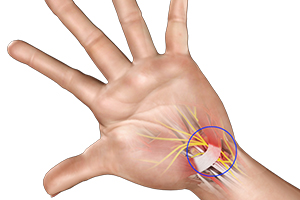
Carpal tunnel syndrome is a common, painful, progressive condition that is caused by compression of the median nerve at the wrist area.

Inflammation and swelling of the tendon sheaths put pressure on the adjacent nerves and leads to pain and numbness in the thumb side of the wrist. Strain on these tendons can cause swelling and irritation, and lead to a condition called De Quervain's tenosynovitis, which is characterized by inflammation. The condition is also referred to as De Quervain’s tendinitis, De Quervain’s tendinosis, De Quervain’s syndrome or De Quervain’s disease.

Ganglion cysts are swellings that most commonly develop along the tendons or joints of wrists or hands. They can be found either at the top of the wrist, palm side of the wrist, end joint of a finger or at the base of a finger. A ganglion cyst is not cancerous and will not spread to the other parts of the body. It looks like a water balloon on a stalk and contains a clear fluid or jelly material. Ganglion cysts can be found in people of all ages.
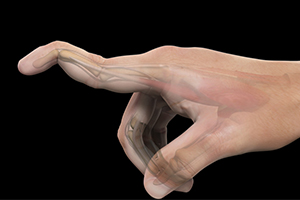
A mallet finger is a condition where the end of the finger is bent and does not straighten. Mallet finger occurs when the extensor tendon at the back of the finger is damaged. Mallet finger occurs due to sports activities (such as baseball) or other activities that cause a direct and forceful impact on the fingers that jam the finger.
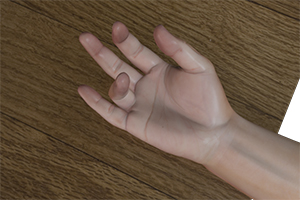
Inflammation in the tenosynovium leads to a condition called trigger finger, also known as stenosing tenosynovitis or flexor tendonitis, where one of the fingers or thumb of the hand is caught in a bent position. The affected digit may straighten with a quick snap, like pulling and releasing the trigger on a gun, hence the name trigger finger.
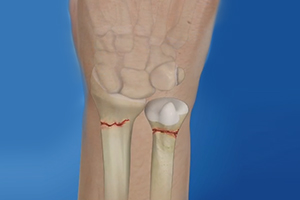
The wrist is comprised of two bones in the forearm, the radius and ulna, and eight tiny carpal bones in the palm. The bones meet to form multiple large and small joints. A wrist fracture refers to a break in one or more of these bones.

If conservative treatment options fail to resolve the condition your surgeon may recommend a surgical procedure. Carpal tunnel syndrome can be treated with carpal tunnel release surgery. Traditional surgery involves an incision of up to 2 inches in the palm and wrist area, whereas endoscopic surgery involves one or two half-an-inch incisions and the use of an endoscope.
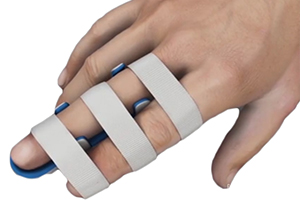
The hand is one of the most flexible and useful parts of our body. Because of overuse in various activities, the hands are more prone to injuries, such as sprains and strains, fractures and dislocations, lacerations and amputations while operating machinery, bracing against a fall and sports-related injuries.

Sports injuries are injuries that most commonly occur during sports and exercises. These injuries may result from accidents, poor training practices, use of improper protective gear, lack of conditioning, and insufficient warm-up and stretching. Sports injuries may be either acute (sprains, fractures, tears) or chronic (tendonitis, overuse injury) injuries.

Wrist arthroscopy is a minimally invasive surgical procedure performed to view, diagnose and treat problems of your wrist joint. Your wrist is a complex joint made up of eight small bones called carpal bones. These bones are supported by connecting ligaments. Various conditions can affect your wrist joint such as carpal tunnel syndrome, osteoarthritis and others.
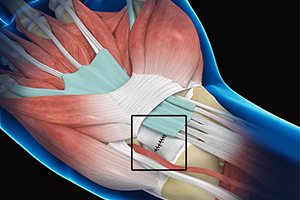
Ligament reconstruction procedure can be performed as day surgery under local or general anesthesia. During the procedure, your surgeon first makes an incision over your wrist joint to locate the torn ligament. Once located, a tendon graft (tissue obtained from a donor part, usually the palmaris longus tendon of the same wrist) is used to replace the torn ligament.
Wrist fractures are breaks in any of the bones that form your wrist joint. Your wrist is made up of 8 small bones present in your hand and the adjacent ends of the 2 long bones of the forearm. The most common sites of fracture in the wrist are at the radius (the large forearm bone) and the scaphoid (one of the small hand bones).
